Sunday, July 22, 2007

Amazingly Good Advice

Thanks to this post on the Bearing Blog; a piece of life advice first given in euchre: "If you can take a trick, do it." In other words, take the opportunities that come along to do a little good, never mind for whom. You're better off reading the original post for examples.

And a bit of self-recognition while reading an entry from yesterday's Wacky Wannabe Musical Monk:

I am fearful that too many folks go around saying "God is Love", without remembering who is hate.


::raises his own hand::

Monday, July 16, 2007

Talk Radio

I'm an opinion and analysis junkie. As a result, I listen to talk radio by preference; besides, there's no classical music on the air where I live. I sure do wish there was.

Today, I heard two monumentally STUPID things on the air. The first was uttered by Rush Limbaugh. After the bottom of the hour break in the first hour, he asked a question he clearly thought was rhetorical: "What's the real downside to staying in Iraq?"

Gee, Rush, if you're an actual fiscal conservative, the words "tax burden" should just LEAP to mind, you know?

The more I listen to Rush, the more apt I find a description I saw put to him some time back: America's Top Republican Ward-Heeler. He's for the Republican Party and their position, whatever it may be. Anything one might have considered a political principle of his, such as cutting spending, gets dumped post haste if it happens to conflict with current Republican political goals. And thus his role is to be sure that all the Republican faithful accept the Republican party line, as though it were infalliable doctrine.

The other was a news item brought up by the local fella who follows Rush. He mentioned that the British National Curriculum is dropping all mention of Winston Churchill, Josef Stalin, Adolph Hitler, Mohandes Ghandi, and Martin Luther King (Jr., presumably). No mention is made in the stories I found as to whether FDR, Neville Chamberlain, Charles de Gaulle, or Benito Mussolini rate a mention. The World Wars and the Shoah (Holocaust) have to be covered, by law; but how on earth are they going to ensure that students know who did it, when, and why, if the only people in history who MUST be mentioned are Abolitionists William Wilberforce and Olaudah Equiano?

I will be very much surprised (and disappointed) if Jewish groups and their friends do not rise up in collective apoplectic uproar over the complete and deliberate ignorance of history being foisted upon British school children. Methinks a home schooling movement may be in the offing there....

Saturday, July 14, 2007

I have GOT to get that book....

Papa Ben's Jesus of Nazareth. It just keeps bringing out such fabulous stuff, like this over at The Heart of Things.

Monday, July 9, 2007

"Sicko-Phancy"! I love it!

This look at health care is an excellent one, and proposes the sort of deregulation that libertarians would appreciate -- allowing medical and dental professionals to practice at a level commensurate with their experience, rather than forcing everyone to go first to an MD or DDS, respectively.

Many thanks to the Western Confucian for tipping me off to this.

Sunday, July 8, 2007

Since You're Reading This...

I clearly have readers. Some of you post comments, and at least one went so far as to exclaim, Read This Blog! Given that, and the discussion of posting my conversion story elsewhere, I've decided that it is in fact appropriate to rename this blog. But I don't plan to rush into it. Papa Ben has ably demonstrated that patience resolves a lot of decisions and conflicts.

Option the First: Crop the name back to "Arkanabar's Eclectic Rants". My desire to focus on heroism will not prevent me from posting on whatever else strikes me as worth bloviating, pontificating, or ranting upon.

Option the Second: Invent some new title that reflects my desire to focus, more or less, on heroism.

Option the Third: Pick a new title from the offerings of my readers. I'd really like that. I'm often lazy.

Obligatory "Journey" Post

Yes, yes, the obligatory conversion story. Lots of Catholic blogs have these. They inspire some of the readers. Who knows, perhaps mine will as well.

I'm a revert, pretty much. I started as a cradle Catholic, but in spite of 4 years of Catholic school and six more of CCD classes, I never really did absorb much of doctrine, and shortly after Confirmation, I was a faithless agnostic, for all practical purposes. I saw no reason to concern myself with spiritual matters, as they could not be demonstrated by scientific means. I never descended to affirming the non-existance of God or anything spiritual.

I suppose it was that, along with associations in science fiction and fantasy fandom, is what led me to dabble in the occult, particularly some neoPagan rituals and Tarot, as well as an eschatological Baha'i cult. I dropped away from those as well, stumbling instead into Amway. My sponsor in Amway opened the trunk of his car shortly after I bought my IBO kit, and told me to borrow whatever books I wanted from his collection there. I wanted a greater understanding of people, so I grabbed Personality Plus by Florence Littauer. It was loaded with Christianity, but I figured that wouldn't prevent me from learning from it. And Mrs. Littauer's explanation of Hippocrates' personality archetypes using axes of outgoing to reserved and task to people oriented made sense and ordered a lot of my thinking on how people tend to think and what they want. (Much the same information can be found at 4marks.com.)

Then, at the end, she drew a simile. She spoke of her two anencephalic children, lovely babies born without brains. She said that knowledge and life without Christ was very much like her children without brains.

I rolled over and moaned, "Oh, my God. Oh, my God." I had just been made aware of the giant God-shaped hole in my life, that I had ignored for over ten years. I wanted Him back, but I didn't want to abandon my self-identity as a thinking person to do so. Of course, the next thing that came along was More Than a Carpenter by Josh McDowell, which convinced me that I was not taking leave of all reason by accepting the historicity of the Gospels. I attended some large functions which included various Protestant evangelists as speakers, and I went to the front a couple of times. But I did not really take up the practice of Christianity.

I got on the internet and found a good friend. She convinced me that Dexter Yager had lied continuously for thirty years about the unprofitable nature of "tools" (also called Business Support Materials), particularly the tapes, and I left Amway behind. But I missed the positive reinforcement of the tapes, so I started listening to radio evangelists. Then Dr. David Jeremiah, of Turning Point broadcast his taped program on Revelations. Though it clearly made him uncomfortable, he presented Alexander Hislop's libellous interpretation of the Whore of Babylon (or possibly Ralph Woodrow's update of it). And I flat out knew he was wrong about the worship of Mary. And hadn't God told Peter not to call profane anything He had made clean? God had cleaned pagan Yule rituals, and made them Christian. And IF the Sign of the Cross had at one point honored Ishtar and Tammuz, couldn't God make it now honor Christ?

(By the way, it turns out that Woodrow repudiated "Babylon Mystery Religion" later on in his life, an act of great courage and honesty, for which he deserve our admiration. He remains an evangelical Charismatic.)

I also participated in an online community pretty much devoted to disputation and arguments about religion and politics. I usually advanced or defended the libertarian position. Somebody there posted some declarations about the Catholic Church that again, I knew were flat out wrong. This time, I did some research, and was able to refute the declarations and provide links to the opposition. From that reasearch, I learned the basis for the Church's claims of authority and infallibility, which I found convincing. I joined the Catholic Exchange community and read nearly everything posted on their portal (still do, it's good stuff). I decided that it was time to return to the Church.

I was visiting my family for Christmas that year, and it was our plan to attend the Christmas Vigil Mass at the parish of my childhood, because they were losing their priest, and they wouldn't be getting another. I knew I desperately needed a good confession to receive the Eucharist, so I spent half the afternoon of Christmas Eve frantically looking for a priest to give me Reconciliation. I was out of luck. In desperation, I called the childhood parish, got hold of the pastor, and begged him to take my confession any time up to a full hour before Mass. He told me he'd be in the confessional fifteen minutes before Mass started. I was greatly relieved.

And it was all wonderful. I hadn't been so filled with joy in years.

The process of conversion is still ongoing, and with the help and guidance of the Church and the Holy Spirit, it will remain so for the rest of my life. I still have trouble with sin, particularly sins of omission. I do not regularly open either my St. Joseph's Edition New American Bible or my Catechism of the Catholic Church, but they're within arm's reach. Still, the introduction of the CCC, which described man's purpose in life, absolutely RIVETED me. It was just THAT good, to know what life is really all about. But at least I know now where I belong, which is within the Church founded by Jesus on Peter, and the root motivation for everything I should do: to know God, and to love and serve Him, with all my heart, all my soul, all my mind, and all my strength.

And I thank God for our separated bretheren, and ask that He bless them. But for them, I very much doubt I would be here. But the most credit MUST go to God, whose grace alone allowed me to find Him.

Saturday, July 7, 2007

Captain America

This post uses the names of a whole bunch of copyrighted characters. Such characters are property of the copyright holders, and I in no way wish to present the notion that I am such.


It's time to write about the late, great Steve Rogers, alias Captain America! I have meant to do so for some time now. For those who don't know the story, it's at Wikipedia. You'd think an Irish-American who grew up in New York in time to come of age during World War II would be strongly Catholic, but for fairly obvious commercial reasons, Marvel never particularly portrayed him that way.

I didn't properly appreciate Cap back when I read comics. Spider-Man was my kind of hero; brainy, smart-mouthed, unconventional, and mighty. Cap was staid, convetional, and (so I thought) utterly stolid. But Captain America was always THE most stand-up hero in the Marvel Universe, bar none. And Steve Rogers was the best man ever to carry the shield. No other was ever so worthy.

Part of the reason I think Cap is so worthy is that, according to his origin stories, he is not particularly superhuman -- his strength, agility, endurance, and toughness are very closely matched by Batman and the Punisher, for example. Thus, he goes forth against insanely powerful enemies with essentially human abilities and an indomitable spirit, and wins. Thus, he has less of the Neitzchean Ubermensch overtones than others in the genre.

Steve Rogers was a man whom I would be glad to see emulated, by ANYONE. He stood for the American Way of truth, justice, service, and liberty. Never mind our failure to live up to our way, that's what he stood for, in costume or not, and he always did his best to live up to it -- doing so better than any other hero in the entire superhero comics genre. Not once can I think of any action he took, which he did not see as being the best way to live up to the ideals of the American Way, and almost always rightly so.

And it is for depriving us of this paragon of adherence to the virtues of truth, justice, service, and liberty, by having him shot to death by a sniper, that I am so very disappointed with the writers over at Mighty Marvel. The more disturbed and distorted the American Way becomes, the more we need a man like Captain America to show us how to truly live up to it.

Thursday, July 5, 2007

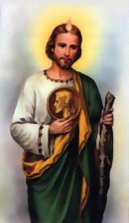
St Jude Thaddeus

Just selected St. Jude as my patron for everything.

Yes, everything.

So, how do I justify making the Patron of Desperate Causes and Things Almost Despaired Of my patron for everything?

Because I've had to face it and admit that when looking within myself, I have cause for desperation. St. Jude reminds me that the ONLY way I can do anything good, the sole hope I have for improvement, is God. Outside of Him, everything is a desperate cause, that I ought to almost despair of.

Catholic Doors has St. Jude novenas here, here, here, and here.

Culture of Death

Sympathizers and fellow-travelers of the homosexual lifestyle movement ask why we consider them to be part of the Culture of Death. This article may shed some light on the violent reality of the culture.

Enough reading on the Theology of the Body will show the reasoning: God created sex so that a husband and wife could be fully open, fully devoted, and fully in union with each other, and so that, like Him, we could bring forth new life. Anytime sex or procreation rejects any of these things, God's purpose, which is love and life, is likewise rejected.

Wednesday, July 4, 2007

A Nation of Independence

I'd be so pleased to write a great essay of my own on the proper role of government in society, but blogger tMichaelB has beaten me to it.

Tuesday, July 3, 2007

Linking to other blogposts

I guess there's a first time for everything. Terry Nelson at Abbey Roads posted this about the parallels between contraception and homosexual sex, and why both are part of the culture of death. My immediate reaction was that his insight deserved a wider audience.

Like a link from MY blog would ever provide that.

Saturday, June 30, 2007

Internet Radio

You may have noticed last Teusday that lots of internet radio stations decided not to broadcast. This is in protest of the FCC's decision to vastly increase the royalties that internet broadcasters must pay.

I can't help but think (as I did the minute I first heard about this) that the royalty increase was done as a favor for XM and Sirius Satellite Radio, and perhaps ClearChannel and the EIB network. Wireless broadband technology is getting more sophisticated and compact all the time, so devices similar to the iPhone are going to be able to bring portable music on demand to people. At that point, demand for satellite radio will drop precipitously, particularly since most people would rather be their own program directors. Also, it would make all the webcasters available on personal-sized devices, thus putting XM and Sirius in direct competition with them. That too would be bad for satellite radio.

Given that the legislative solution that webcasters are proposing is to make their royalty rates the same as those for satellite radio, this particular notion of mine has been greatly reinforced.

This just brings to the fore one of my regular libertarian contentions: big government is the friend of big business and the enemy of small business, and regulators are typically in the pockets of big businesses, and regulations are most often designed to impede small businesses. Consumers lose out, since the government prevents them from having choices that others wanted to give them.

Basically, Big Business gives Big Money to Big Government, with the result being that the guns used to enforce these malum prohibitum regulations are pointed at their smaller, more agile competitors. The government becomes Big Business's goon, shutting down competition with violence, just like gangsters used to during Prohibition. We do so much better when the government just lets those businesses that are dealing honestly be.

Man-Thing

I have nowhere near as much depth in my observations on Marvel's worst movie ever, Man-Thing, as the B-Movie Catechist, but there's still something I have to say that he didn't ... especially since it was just on SciFi.

The Man-Thing of the movie is a perfect realization of the god of Environmentalism: inhuman, equally eager to see all humans dead, be they allies or enemies, and struggling, even when the offenses against it are repented, to continue murdering.

Ghost Rider


I saw Mighty Marvel's most recent DVD, Ghost Rider, last night. I had tremendous fun watching it, even though I have never been a great fan of the Ghost Rider comics. It stars Nicholas Cage, Peter Fonda, and Sam Elliot, all of whom I consider to be top performers. It is a ripping good yarn, IMO.

Naturally, being Hollywood entertainment, it is rife with bad theology and bad choices. Superhero entertainment is particularly susceptible to this, with all of its Nietzchean overtones. But for a story to be enjoyable, it has to have some truth in it, so there are also good bits you can take away from it.

Like a lot of people, Johnny Blaze's first encounter with the supernatural was with the demonic, in the character of Mephistopheles, the personification of Satan's deceptive ways. The first lesson is, when you do not promptly send evil away, you can get shafted before you know it, and the good things that are offered are really only a cheat.

From his father's death until Mephistopheles activates him as the Ghost Rider, Johnny searches for an escape from his contract and asks if it's possible that he can have a second chance. This is the same mistake that Faust made in Marlowe's play; he remains blind to God's ability to save him , no matter how far he falls. (The notion that one must deliberately sell one's soul to the Devil for him to have any claim on it is likewise deception; rejecting God will do it.)

Blaze seeks to use the power Mephistopheles has imparted to him to do good. This is at best suspect. On the one hand, God can do whatever He wants, including turn around the most horrible of situations. On the other, there really isn't any way you can hope for a good end by doing evil. This is why good ends cannot justify evil means. In the real world, magic comes from the devil, and its use will not lead to good. (See this story and this one for examples of what I mean.) The Devil isn't about to hand out the power to punish evil, as the character Mephistopheles does. On our own, we do not have the power to resist the Devil; such power comes to us only from the grace of God.

The Caretaker tells Blaze that, because his motivation for dealing with the Devil was love, God was with him. This is truth; God loves everyone who seeks to do good and all good works, no matter who does them or why.

In the end, Mephistopheles offers to remove the curse he placed on Johnny Blaze and restore his soul. This time, Blaze refuses him. This was the right decision. First, whatever the Devil offers is a cheat and a lie. Second, since his power gives retribution to evil, it is good. Third, he recognizes and accepts the redemptive power of suffering.

Franz Jägerstätter, martyr, Beatus

I'd finished with Catholic Caveman, and wandered over to Catholic Anarchy. Yeah, the two are very different. I fully agree with the Caveman on the need for more manliness, particularly in the Church. And I agree with Michael Iafrate over at Catholic Anarchy, that we ought not have invaded Iraq. I expect that he and I are fellow=travelers regarding the War on Terror as well. But this here is my blog, and I'd like to write about Franz Jägerstätter, who came to my attention via Catholic Anarchy.

Jägerstätter was one of many Catholics martyred by the Third Reich. St. Benedicta of the Cross (Edith Stien) was martyred for being a Jewish convert to Catholicism in a city where the Catholic Church decried the Nazi deportation of Jews from every pulpit. St. Maximillian Kolbe was arrested and sent to Auschwitz for sheltering some 2,000 Jews in his Franciscan friary and speaking out against the Nazis via amateur radio. He was killed because he thought it better that he should die than Franciszek Gajowniczek, who had a family. But Jägerstätter was killed for one reason only: he refused to carry a rifle for Hitler. And he refused because he recognized, as Pope Pius XII made clear in Summi Pontificatus, that Naziism was clearly incompatible with authentic Christianity. He offered to carry medical supplies and serve as a medic in the Wehrmacht, but that wasn't enough, and he was executed for it. Refusing to aid in evil, regardless of the cost, is heroism worthy of our respect, and emulation if possible and/or necessary.

Most of what I've seen praising Jägerstätter comes from voices that seem to abhor war unreservedly and praise pacifism in every case. (edit: thanks to The Western Confucian, I have found this exception.) Nothing I've seen suggests that he would have been such a voice. He saw that the Nazi Party, in both ideology and action, was completely unChristian, and he refused to take even the most limited part in their evil. But I saw no sign that he would have had similar objections to bearing arms in just defense of his nation. In my opinion, the war against the Axis was a just war, though at times conducted unjustly. Of course, the Axis made it so much more difficult by how they conducted themselves. The point I'm trying to make is that first, it is necessary to fight evil in every case. But even in fighting great evil -- and the evil of the Axis was very great -- one must not succumb to the temptation to fight evil by doing evil.

Wednesday, June 27, 2007

Pastor Johannes Lerle

Pastor Johannes Lerle is a Lutheran minister in Erlangen, Bavaria. For the third time, he has been sentenced to jail, this time at a bench trial, for the crime of Volksverhetzung, or incitement of the people. His sentence shall be one year in jail.

What did he do? He said that murdering unborn children (i.e., abortion), is no better than gassing Jews at Auschwitz. I consider this an obvious parallel. Unborn people are people, just as Jews are people. But Judge Erda Erdenhofner has construed it as denying the Holocaust!

I beg to differ. A law saying that an unborn person is not a person is every bit as bad as one saying a Jew is not a person. In order to accept abortion, one must depersonalize the unborn, just as accepting the Final Solution required depersonalizing the Jews, Slavs, homosexuals, handicapped, and Catholics who were its victims. It's not like we're talking about cattle or chickens, here; we're talking about people. (Although it's possible, albeit revolting, that he would have been commended for comparing a meat-packing plant to Auschwitz. Pamela Anderson would be proud of anyone who did that.)

You could suggest to Amnesty International that they add Pastor Lerle to their list of prisoners of conscience, but I wouldn't hold my breath. They have capitulated to the strident and bellicose purveyors and promoters of abortion on demand, and are unlikely to have the courage to defend somebody imprisoned for describing abortion as what it actually is, when they no longer have the courage to do so themselves.

Saturday, June 23, 2007

Heroes

I've decided that heroism is a fitting theme for a manly blog. Our culture denigrates manliness, and winds up losing heroism by extension. So it is my intention, whenever I find a fitting example of heroic manliness, to post about it here.

For example, consider The Servants of God, also known as the Georgia Martyrs. These five men had no discernable fear of death. They preached the Gospel, and by extension, monogamy, to a culture that was completely polygamous. When the chief's heir married a second woman, they told him they could not support his political aspirations unless he ceased his bigamy. He got some friends together, and they killed all five of the Servants of God.

The Servants of God are vital heroes for today; we needneed men who will stand up and die, if need be, to preserve the sanctity of marriage. Never has it been so sorely pressed. Traditional marriage is a public good as I define it.

O Lord Jesus Christ, reward the apostolic zeal of Fray Pedro de Corpa and his four Companion friars, Blas, Miguel, Antonio, and Francisco, who labored for the spiritual well-being of the Natives of Georgia and gave their lives in witness to the Christian faith. Through their merits and intercession graciously grant the favor I humbly ask of You, that our society recognize the importance of marriage and come to protect it fervently, so that, for the glory of Your Name, their heroic sacrifice may be officially recognized by the Church. Amen.

p.s. I found the Servants of God in a comment box over at Ask Sister Mary Martha's Blog, which I intend to peruse fully, including all other comboxes.

Friday, June 22, 2007

MMORPGS

Those who have read my site can easily guess that I love pen and paper, people and polyhedron RPGs far more than computer RPGs. Given the choice, I'll take P&P over CRPG, whether online or off, massively multiplayer or solo. But I don't have the choice, and I feel like ruminating and offering advice on what I am able to do -- for the complete beginner, of course.

A good Player vs. Enemy (or Electronics or Mob or Monster) group will have a balanced selection of classes, each of which will fill specific roles. These are called by different names in different games, and I generally like the Archetypes in City of Heroes best, even though my MMORPGs are Dark Age of Camelot, World of Warcraft, and Ultima Online.

Tank: This indicates a class with heavy armor, lots of hit points, and the ability to generate threat (also known as drawing aggro). In DAoC (Hibernia forever!), the premier tanks are the Hibernian Hero and Champion, the Albion Armsman and Paladin, and the Midgardian Warrior. In WoW, it's the Warrior. It's my favorite in WoW. His role is to stand in front and take the beatings ... and to pull enemies away from blasters and healers.

Blaster: (aka Nuker): This is a class with light or no armor, and phenomenal damage, usually at range. In WoW, this is generally a mage, a warlock, or a shadow-spec priest; in DAoC, it's any sort of spellcaster, as well as any bow-primary class.

Controller: The problem with a large player group or party is that enemies are programmed to respond to attacks in groups. The controller prevents some of the responding enemies from attacking. Controls vary: stuns prevent all action, generally for a brief time; roots prevent enemy movement, often until taking damage; snares slow movement, and mezmerizes prevent all action until damage is taken. In DAoC, controllers are usually also the healers, and do the buff spells. In WoW, mages have a mez, a chill, and a freeze, warriors and hunters have a snare, and that's about it.

Scrapper: The scrapper is a frontline fighter, who does more damage but has less armor than the tank. If he is not pressed into service as the tank, his ideal role is finishing off other peoples' foes, or stripping attackers from blasters, controllers, and healers. In DAoC, the scrappers are the Hibernian Blademaster, the Albion Friar and Mercenary, and the Midgardian Berzerker. In WoW, there isn't quite a scrapper class; rather, it's a spec for warriors, hunters, paladins, and druids.

Stalkers: These use stealth, poisons, and two weapons. They act alone and do not fit neatly into a group role, except perhaps the scrapper's role, though they do more damage and are not so well defended. In DAoC, the stalkers are the Hibernian Nightshade, the Albion Assassin, and the Midgardian Shadowblade. In World of Warcraft, it's the Rogue.

Hybrids: Hybrids serve in two or more archetypical roles. Pet classes are almost inherently hybridized; any pet can serve as a tank. World of Warcraft's hybrids are the Hunter (elements of the blaster, the scrapper, and (through the pet) the tank); the warlock (mostly a blaster; his summoned creature orients towards either blaster, tank, or scrapper); the paladin (healer/tank); the druid (tank OR healer/blaster); and the shaman (elements of healer, blaster, and scrapper). In DAoC, hybrids are everywhere. Hibernia's hybrids are the druid (pet healer); warden (fighter /healer /buffer); ranger (blaster/stalker or else blaster/light scrapper); enchanter (pet / blaster). Albion's hybrids are the friar (healer/ scrapper), the elementalist (pet/ blaster), paladin (tank/healer -- a synergy that makes him the greatest tank in the game), the minstrel (buffer/ controller /stalker), and probably some more I don't remember. Midgard ... has a hunter, a pet/blaster hybrid, the thane (tank / blaster), and surely more, but again, I don't remember.

In World of Warcraft, my favorite is the protection warrior. This is not a popular build, but I enjoy the sheer heroic manliness of the role that the protection warrior fills. He protects everyone else as best he can, by sacrificing his own hit points and armor. Yes, he has to count on a healer to keep him alive in longer fights. But the fact is, his job is, if at all possible, to be the first to die.

As Lazarus Long accurately opined, unless "women and children first" is the sentiment at the basis of a civilization, it is suicidal. This leaves adult men to die so that others can live. That becomes the essence of manliness, which is why I find the protection warrior to be so appealing.

Tuesday, April 24, 2007

the tragedy BEFORE the VT shooting

Thank you, Michelle Dickerson, for saying this:

In the aftermath of tragedy lies our answer. Love. Not just from being caught up in the emotions of the moment, but love at all times. We treat love as a feeling, but ultimately it is a choice, a decision we make. We can choose to love or not to love. The decision is ours to make. It is in our hands. No one can force us to love. To love only when it is convenient is not love.


Michelle aptly points out that the great tragedy is that most of the time, we choose to ignore most or sometimes all the chances we're given to love one another -- until some great tragedy reminds us that we don't have forever to give our love to others.

And she points out that love is a choice. That is one of the most important lessons I've ever learned. I'll say it again, for emphasis: one of the most important lessons I've ever learned is that love is not a feeling, no quiver in the liver or other physical or emotional sensation, but a choice to do something loving for another.

Pray for more to find a vocation of charity!

Found this article on red tape and charity today. In it, Maria Peceli describes the difficulties she had in getting one package of diapers out of a food bank, without having to put her kids in day care.

This is the legacy of a government-funded "charity." If I recall correctly, it was John Paul II the Great who told us that a government cannot give people love. As the title of Papa Ben's first encyclical ought to remind us, the root word of "charity" is "caritas," love. If a government cannot give people love, how can it give people charity?

The red tape is pretty much an insuperable problem for a government aid organization. Government agencies of all types inevitably attract the attention of some crusading politician who searches it for fraud and/or waste, and when he inevitably finds it, he gets on his soapbox and "does something about it" so he can brag about that, come the election. The result is the sort of red tape that almost strangled the charity out of the food bank where Maria Peceli sought one package of diapers.

One of my older rants expresses my discomfort and dislike, when it comes to tax-funded relief and aid, particularly grants to faith-based charities. But something I realized later, and never put there, is this: there are two sides to Matthew 22:21. The first is to give to the government the things which are proper to it, such as defending our lives, liberty, and property. The other is to give to God the things which are proper to the Body of Christ, such as charity and good works. We have handed over the work of the Body of Christ to our Caesar, and then congratulated ourselves for it. How should we answer if God should ask us, "Why did you stop doing My work, and assign it to others who do not follow Me?"