Wednesday, May 16, 2012
I Love This Video
Salute to Creative Minority Report. Watching it, I could not help but laugh with delight.
Enjoy!


Sunday, May 13, 2012
Whatever could be wrong with porn?
Tatsuya Ishida, creator of Sinfest, is growing up. Contrast one of his most recent:
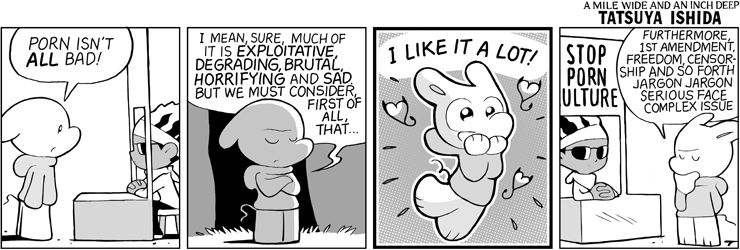
with some early work which involves recognition for sluts, tramps, and hos. I'm proud of him for facing up to the truth about pornography, and hope he continues to progress. Incidentally, this one starts my favorite series in the strip, a theme revisited here and here, oh, and here. Whoops -- here too.
with some early work which involves recognition for sluts, tramps, and hos. I'm proud of him for facing up to the truth about pornography, and hope he continues to progress. Incidentally, this one starts my favorite series in the strip, a theme revisited here and here, oh, and here. Whoops -- here too.
Tuesday, May 8, 2012
Prophecy
Written in 1968:
It is also to be feared that the man, growing used to the employment of anti-conceptive practices, may finally lose respect for the woman and, no longer caring for her physical and psychological equilibrium, may come to the point of considering her as a mere instrument of selfish enjoyment, and no longer as his respected and beloved companion.Published in 2010:
The notion that Playboy turns women into sex objects is ridiculous. Women are sex objects. If women weren't sex objects, there wouldn't be another generation. It's the attraction between the sexes that makes the world go 'round. That's why women wear lipstick and short skirts.
Wednesday, April 25, 2012
Assembly Not Required
Salute to Mark Shea.
Behold the People's Rights Amendment:
Behold the People's Rights Amendment:
Section 1. We the people who ordain and establish this Constitution intend the rights protected by this Constitution to be the rights of natural persons.Did any of you notice what was missing from Section 3?
Section 2. People, person, or persons as used in this Constitution does not include corporations, limited liability companies or other corporate entities established by the laws of any state, the United States, or any foreign state, and such corporate entities are subject to such regulation as the people, through their elected state and federal representatives, deem reasonable and are otherwise consistent with the powers of Congress and the States under this Constitution.
Section 3. Nothing contained herein shall be construed to limit the people's rights of freedom of speech, freedom of the press, free exercise of religion, and such other rights of the people, which rights are inalienable.
Congress shall make no law respecting an establishment of religion, or prohibiting the free exercise thereof; or abridging the freedom of speech, or of the press; or the right of the people peaceably to assemble, and to petition the Government for a redress of grievances. SourceMost forms of "peaceable assembly" are corporations. What this amendment allows the government to do is to presume that once you're standing with others in any sort of legally organized body or structure (other than government, itself), you do not have the rights of people. Here's the article.
Saturday, April 14, 2012
To Aid Pornchai Maximillian Moontri
If you do not read These Stone Walls, you should. Fr. Gordon Macrae is a very compelling writer.
This week, Fr. Gordon has a guest poster -- his cellmate, Pornchai Maximillian Moontri, a recent convert to Holy Mother Church. He may be released shortly from prison. When this happens, he will be immediately deported to Thailand, the land of his birth. He knows nobody there. Those who have said before that they would help him when he arrives there have not communicated recently.
I ask any of my readers who have any contact within Thailand to make use of them. See if you can find any help for Pornchai where he has to go. If you do, contact Fr. Gordon. Even if you can't, please spread this message. Somebody somewhere knows somebody who can extend to Pornchai the Christian charity he needs.
This week, Fr. Gordon has a guest poster -- his cellmate, Pornchai Maximillian Moontri, a recent convert to Holy Mother Church. He may be released shortly from prison. When this happens, he will be immediately deported to Thailand, the land of his birth. He knows nobody there. Those who have said before that they would help him when he arrives there have not communicated recently.
I ask any of my readers who have any contact within Thailand to make use of them. See if you can find any help for Pornchai where he has to go. If you do, contact Fr. Gordon. Even if you can't, please spread this message. Somebody somewhere knows somebody who can extend to Pornchai the Christian charity he needs.
Thursday, April 12, 2012
Paying to Starve the Poor, part II
I've used this post title before, and I urge you to go read it. Salute to Mark Shea (see his commentary), who brought the following to my attention:
Ethanol Policy Not Producing Desired Results
Some takeaways: Ethanol policy benefit? $24/yr for a family using about 1100 gallons (4164 liters) a year, about 2.2 cents per gallon. Expenses?
Is the 0.08% reduction in world greenhouse gas emissions worth it?
Ethanol Policy Not Producing Desired Results
Some takeaways: Ethanol policy benefit? $24/yr for a family using about 1100 gallons (4164 liters) a year, about 2.2 cents per gallon. Expenses?
[T]he United Nations’ FAO Food Price Index which shows that between Jan. 2007 and Sept. 2011, after adjusting for inflation, corn prices increased by 68 percent, cereals by 69 percent and dairy products by 46 percent.In case you're wondering, "cereals" means all grain crops, which make up the primary source of protein for most of the world's poor, who in many cases spend 50% of income (or more) on food. When food prices rise 69%, that means they must now spend 84.5% of income on food to maintain the same food intake. This is usually not a tenable position for them; perforce, they starve.
One study (Hayes et al, 2009) the researchers cite quantifies how a $1 per bushel increase in corn prices impacts a wide variety of food products. The study shows, for example, that between 2005 and 2011 corn prices rose by $5 per bushel, beef rose 18.5 percent, pork 16 percent, poultry 17.5 percent, eggs 27.5 percent, milk 10.5 percent, cheese 9 percent, sugar and sweets 3.5 percent.
The researchers claim that not all these price increases are due to U.S. ethanol policies. However, even “if only one-fourth of this additional expenditure is attributable to ethanol, this would imply a loss to American consumers of $40 billion over the last 4 years.”
Is the 0.08% reduction in world greenhouse gas emissions worth it?
Sunday, April 8, 2012
What Works In Computing
Salute to Jeff Hooglund, project lead for Bodhi Linux (and some other software).
So what doesn't linux do?
The desktop -- at least, not in the G7/ G20. Not that it can't do desktop, just that it's annoying to get some things to work, or there's no support for linux systems (Netflix, Photoshop, Adobe Illustrator, some games, read Microsoft Office files cleanly). Sometimes, people deliberately make stuff so it can't be made to work with linux (anything having to do with digital rights management). It is really good for surfing, email, word processing, photo management, and instant messaging, not to mention music production, Myth TV, reviving old machines, resisting malware, and almost anything else that the development community finds interesting.
You can try linux without installing it. Just don't expect it to be like windows. A Tesla Electric Roadster is going to be very different from a Lotus Elise, in spite of the similarity in appearance and function. Live CDs/DVDs are a long-standing way to try and often install linux. If your computer can boot from a thumb drive, you can copy a live cd/dvd ISO file to it (see the Pendrive Linux site). There are tons of distros that can be tried in this manner. Search for them on DuckDuckGo.com or Ixquick.com and you'll find relevant links quickly.
Some distros are better suited to desktop use than others. Regardless, you will want to make sure important data is backed up and your hard disk is defragmented before you start. Search the web and read the forums when you have problems. For those coming from Windows with no knowledge of Linux, I'd recommend the following:
Geek Level 0:
Linux Mint (if you're a long-term Windows user, particularly the KDE edition)
Ubuntu (if you don't consider yourself much of a windows user, and/or the TaskBar and Start Menu don't make sense to you)
Lubuntu (if you don't like the Unity Interface; there will be changes to it come April 26 2012)
PCLinuxOS (the first distro I ever installed)
openSUSE (the oldest commercial distro)
Puppy (especially if you're using old hardware)
SimplyMEPIS 11 (some complain about installer design, but it's fast and stable once installed)
Geek Level I: Video drivers and/or wireless and/or printing may require research.
Scientific Linux (if you prize stability -- it's a clone of Red Hat from CERN)
SalixOS (again for stability -- it's the lazy man's Slackware)
Linux Mint Debian Edition
Archbang (speed, cutting edge)
Crunchbang (speed, stability)
Fedora (bleeding edge)
Sabayon (bleeding edge)
PC-BSD (not linux, but Unix.)
Geek Level II: Configuration will require knowlege and research.
Debian Linux (stability again)
Slackware (stability again)
Arch Linux (speed, bleeding edge, super-customizable -- regarded as the hot rod of linux)
Semplice (speed, bleeding edge -- this is a Debian Sid distro)
Siduction, Aptosid (bleeding edge -- these are 2 other Debian Sid distros)
Geek Level III: You're happy to compile everything from source.
Gentoo Linux
Linux From Scratch (this is a book of instructions, not a software compilation)
So what doesn't linux do?
The desktop -- at least, not in the G7/ G20. Not that it can't do desktop, just that it's annoying to get some things to work, or there's no support for linux systems (Netflix, Photoshop, Adobe Illustrator, some games, read Microsoft Office files cleanly). Sometimes, people deliberately make stuff so it can't be made to work with linux (anything having to do with digital rights management). It is really good for surfing, email, word processing, photo management, and instant messaging, not to mention music production, Myth TV, reviving old machines, resisting malware, and almost anything else that the development community finds interesting.
You can try linux without installing it. Just don't expect it to be like windows. A Tesla Electric Roadster is going to be very different from a Lotus Elise, in spite of the similarity in appearance and function. Live CDs/DVDs are a long-standing way to try and often install linux. If your computer can boot from a thumb drive, you can copy a live cd/dvd ISO file to it (see the Pendrive Linux site). There are tons of distros that can be tried in this manner. Search for them on DuckDuckGo.com or Ixquick.com and you'll find relevant links quickly.
Some distros are better suited to desktop use than others. Regardless, you will want to make sure important data is backed up and your hard disk is defragmented before you start. Search the web and read the forums when you have problems. For those coming from Windows with no knowledge of Linux, I'd recommend the following:
Geek Level 0:
Linux Mint (if you're a long-term Windows user, particularly the KDE edition)
Ubuntu (if you don't consider yourself much of a windows user, and/or the TaskBar and Start Menu don't make sense to you)
Lubuntu (if you don't like the Unity Interface; there will be changes to it come April 26 2012)
PCLinuxOS (the first distro I ever installed)
openSUSE (the oldest commercial distro)
Puppy (especially if you're using old hardware)
SimplyMEPIS 11 (some complain about installer design, but it's fast and stable once installed)
Geek Level I: Video drivers and/or wireless and/or printing may require research.
Scientific Linux (if you prize stability -- it's a clone of Red Hat from CERN)
SalixOS (again for stability -- it's the lazy man's Slackware)
Linux Mint Debian Edition
Archbang (speed, cutting edge)
Crunchbang (speed, stability)
Fedora (bleeding edge)
Sabayon (bleeding edge)
PC-BSD (not linux, but Unix.)
Geek Level II: Configuration will require knowlege and research.
Debian Linux (stability again)
Slackware (stability again)
Arch Linux (speed, bleeding edge, super-customizable -- regarded as the hot rod of linux)
Semplice (speed, bleeding edge -- this is a Debian Sid distro)
Siduction, Aptosid (bleeding edge -- these are 2 other Debian Sid distros)
Geek Level III: You're happy to compile everything from source.
Gentoo Linux
Linux From Scratch (this is a book of instructions, not a software compilation)
Friday, April 6, 2012
Toward More Open Government
I have just added to the "Other Links" section of the sidebar The Sunlight Foundation, which I found on Linux Today. They act to make government more transparent and accountable. Thus far I've only skimmed their site, but what I've seen I like. I recommend adding them to your bookmarks. I'd prefer to have a government I didn't have to fear, but since I don't, I'll take the tools I can get to make it a servant of the people, rather than our overlord.
Friday, March 30, 2012
Lazy Press Is Lazy
How many times have you heard pro-life people denounced in the news with a declaration along the lines of "You people only care about the fetuses; once a baby's born, you kick them and the mothers to the curb!" As Simcha Fisher ably demonstrates, this is absolutely a canard, a slander, and a lie. And then she links to a further demonstration of the accusation's falsehood.
Tuesday, March 27, 2012
Blogrollin' on Birth Control
salute to Tito Edwards.
Turns out that it's reasonable to expect that 59% of girls who start on birth control when they're 15 to have at least one unintended pregnancy by the time they're 25. Here's the math.
Turns out that it's reasonable to expect that 59% of girls who start on birth control when they're 15 to have at least one unintended pregnancy by the time they're 25. Here's the math.
Thursday, March 8, 2012
The Top 10, Plus Truth
Behold! The Top 10 Arguments For the Mandate, Refuted By Truth!
Salute to Frank Weathers of YIMCatholic, who consistently writes better stuff than I do.
EDIT: More truth,from The Crescat: Sex Is Not a Medical Emergency! Salute to Thomas L. McDonald of God and the Machine at Patheos.
Salute to Frank Weathers of YIMCatholic, who consistently writes better stuff than I do.
EDIT: More truth,from The Crescat: Sex Is Not a Medical Emergency! Salute to Thomas L. McDonald of God and the Machine at Patheos.
Monday, March 5, 2012
A piece of truth
Salute to Mark Shea, the Anchoress, Frank Weathers of yimcatholic at patheos, etc. etc. etc.
Sunday, March 4, 2012
On infanticide (blogrollin')
There is apparently a pair of bioethicists who claim it is moral to perform post-birth abortions, which are somehow not the same thing as infanticide, in spite of both being the act of intentionally slaying an infant member of the species Homo Sapiens. I have no intention of linking to the article. Rather, I link to William Briggs' most excellent fisking, in which he points out the myriad of fallacies, false premises, non sequiturs, and most important, their failure to point out with anything approaching precision when infanticide becomes moral.
Salute to John C. Wright, comments further.
Salute to John C. Wright, comments further.
Wednesday, February 22, 2012
Justice and Prison
I have thought for some time that our prison system was unjust. It turns out that it's also unneccessary. An article in the New Yorker addresses both the injustice of our prisons, and what reduces crime.
One problem is that our justice system is misnamed. It is a criminal prosecution system. Its interest is not in justice and common law, but in statues, regulations, and procedural correctness. Prosecutors do their best to ensure that exculpatory evidence is never introduced, and work assiduously to avoid jury trials (to save time and money), and juries are never told to consider justice in convicting and giving sentencing recommendations. Is this a prudent way for a just society to order their priorities? Are time and money more important than justice?
A more just punishment would involve restitution, not incarceration. Stealing should involve not just paying back what you stole, but being forbidden the opportunities you used to steal. Embezzlers should not be allowed to go back into positions where they have authority over money.
Crime is prevented by simple things like reducing opportunities to commit them. Dr. Ruwart pointed out almost 20 years ago that if you reward police for reducing crime, instead of convicting criminals, they will act to do so -- and save us money in the process.
Another simple way to reduce crime is not punishing people for owning or using a little weed. (No, I don't use or approve of weed. I'd rather have a drink myself, even though I can readily recognize that ethanol causes a lot more adverse medical outcomes, that can easily be a lot more serious.) Relegalizing opioids and cocaine can come later.
One problem is that our justice system is misnamed. It is a criminal prosecution system. Its interest is not in justice and common law, but in statues, regulations, and procedural correctness. Prosecutors do their best to ensure that exculpatory evidence is never introduced, and work assiduously to avoid jury trials (to save time and money), and juries are never told to consider justice in convicting and giving sentencing recommendations. Is this a prudent way for a just society to order their priorities? Are time and money more important than justice?
A more just punishment would involve restitution, not incarceration. Stealing should involve not just paying back what you stole, but being forbidden the opportunities you used to steal. Embezzlers should not be allowed to go back into positions where they have authority over money.
Crime is prevented by simple things like reducing opportunities to commit them. Dr. Ruwart pointed out almost 20 years ago that if you reward police for reducing crime, instead of convicting criminals, they will act to do so -- and save us money in the process.
Another simple way to reduce crime is not punishing people for owning or using a little weed. (No, I don't use or approve of weed. I'd rather have a drink myself, even though I can readily recognize that ethanol causes a lot more adverse medical outcomes, that can easily be a lot more serious.) Relegalizing opioids and cocaine can come later.
Sunday, February 12, 2012
So-Called "PIPA"

The inoffensive guy in the glasses more or less represents Rep. Lamar Smith. The things he's talking about in the third and fifth panels are provisions of HR 1981, the so-called "Protecting Children from Internet Pornographers Act", aptly nicknamed the "Keep Every Americans' Digital Data for Submission to the Federal Government Without a Warrant Act." (You can sign a petition opposing HR 1981 here.) More information from TechDirt here and here.
Studios and Samizdat
Just read a couple of great articles on copyright infringment over at forbes.com: You Will Never Kill Piracy, and Piracy Will Never Kill You and Lies, Damned Lies, and Piracy.
They both mostly cover the same ground: one of the biggest reasons that people use samizdat rather than buy content is because it is easier. The MPAA could build something like Steam or iTunes, and blow giant holes in the number of samizdat downloads. Another is that movies are grossly (and grotesquely) overpriced, both in production and for the end-user. And studios and labels are increasingly profitable, even as samizdat increases.
They both mostly cover the same ground: one of the biggest reasons that people use samizdat rather than buy content is because it is easier. The MPAA could build something like Steam or iTunes, and blow giant holes in the number of samizdat downloads. Another is that movies are grossly (and grotesquely) overpriced, both in production and for the end-user. And studios and labels are increasingly profitable, even as samizdat increases.
On so-called Piracy
Words mean things. Piracy means ship-to-ship armed robbery and hijacking on the high seas, even today; witness Somalian pirates. There is piracy in the Carribean sea as well. The act involves threats to people's lives and property.
Samizdat (from "same as that") was a practice used to escape censorship in the Soviet union -- to type out a verbatim copy of a banned book, generally on a manual typewriter. It is a much better word than piracy to describe modern methods of copyright infringment, which threaten only royalties, not anyone's lives or actual property. You can expect me to use it instead. I encourage you to do the same, even though those in the networks will not, because they are beholden to the labels and studios.
Samizdat (from "same as that") was a practice used to escape censorship in the Soviet union -- to type out a verbatim copy of a banned book, generally on a manual typewriter. It is a much better word than piracy to describe modern methods of copyright infringment, which threaten only royalties, not anyone's lives or actual property. You can expect me to use it instead. I encourage you to do the same, even though those in the networks will not, because they are beholden to the labels and studios.
Wednesday, February 8, 2012
What SOPA and PIPA are meant to do
I just saw a headline that has put SOPA and PIPA into perspective: BTJunkie voluntarily closes file-sharing website (more from ZDNet, Loopy Gadgets, and the Guardian).
The goal of SOPA/PIPA is not to stop piracy.
It is nothing less than to put an end to user-generated content on the Web.
That's the real goal of MPAA and RIAA in all their censorship moves and DRM strategies -- to ensure they have a monopoly on distribution of entertainment media worldwide.
They want to eliminate every form of competition. They want to ensure that all independent entertainers are crushed, so that everyone who wants any sort of entertainment will have to come to them, cash in hand. They want to ensure that every musician will have to come to them, cap in hand, to sign away all of their rights and money, in order to make the move from street corner busker/ garage band/ small local club band to the big time. They want to ensure that nobody ever successfully distributes a film without the studios getting their piece of the action.
And this plays into the hands of a censorious government. Never forget that big government and big business are in bed together and feed each other. Big business wants an unfair advantage. Big government wants to control personal expression. An oppressive government cannot afford free expression; it's far too likely to express, in a way that people can easily see and share, that the government is oppressive and corrupt.
BTJunkie's self-takedown is not ONLY stifling piracy, is not ONLY stifling Linux ISO distribution (most Linux ISOs are distributed over bittorrent to save costs) ... I have no doubt that it is also stifling the efforts of many independent artists, without labels or studio contracts, to get some market share and mind share.
The goal of SOPA/PIPA is not to stop piracy.
It is nothing less than to put an end to user-generated content on the Web.
That's the real goal of MPAA and RIAA in all their censorship moves and DRM strategies -- to ensure they have a monopoly on distribution of entertainment media worldwide.
They want to eliminate every form of competition. They want to ensure that all independent entertainers are crushed, so that everyone who wants any sort of entertainment will have to come to them, cash in hand. They want to ensure that every musician will have to come to them, cap in hand, to sign away all of their rights and money, in order to make the move from street corner busker/ garage band/ small local club band to the big time. They want to ensure that nobody ever successfully distributes a film without the studios getting their piece of the action.
And this plays into the hands of a censorious government. Never forget that big government and big business are in bed together and feed each other. Big business wants an unfair advantage. Big government wants to control personal expression. An oppressive government cannot afford free expression; it's far too likely to express, in a way that people can easily see and share, that the government is oppressive and corrupt.
BTJunkie's self-takedown is not ONLY stifling piracy, is not ONLY stifling Linux ISO distribution (most Linux ISOs are distributed over bittorrent to save costs) ... I have no doubt that it is also stifling the efforts of many independent artists, without labels or studio contracts, to get some market share and mind share.
Thursday, February 2, 2012
Telling the Truth
John C. Wright posts about Christopher Stasheff, the only SF author who had the guts to put the truth about chastity into the mouth of one of his characters. Go and read it, as it is an EXCELLENT explanation of the spiritual dangers of fornication.
Sunday, January 29, 2012
Sign Frank's Petition!
Frank Weathers, of YIMCatholic at Patheos, has created a petition to ask that the vile HHS mandate to require Catholic institutions to directly fund gravely evil acts in contradiction of religious liberty. Go and sign. Yes, you have to create an account. Be not afraid!!
Petition page here
Incidentally, Frank has yet another one of those Catholic blogs far superior to mine.
Petition page here
Incidentally, Frank has yet another one of those Catholic blogs far superior to mine.
Subscribe to:
Posts (Atom)